
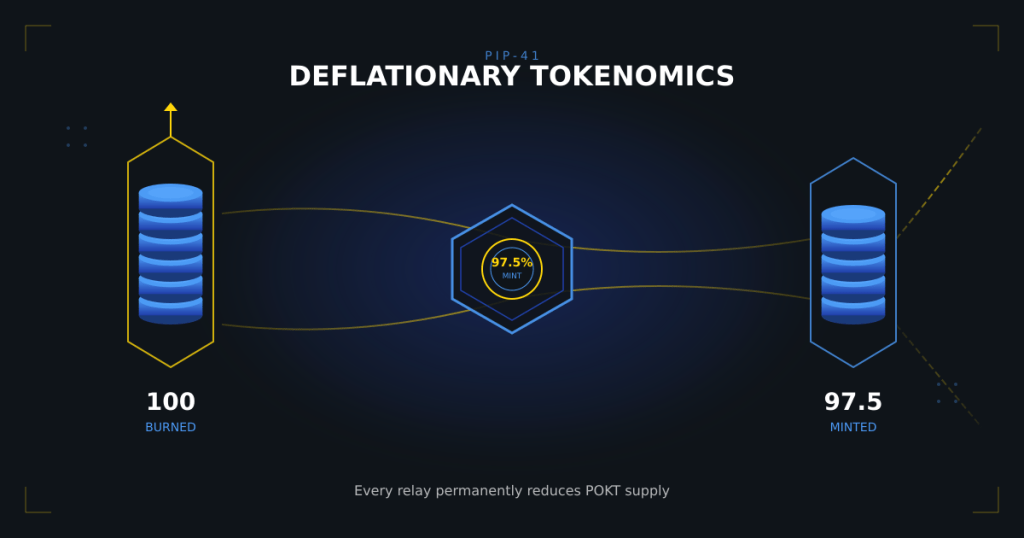
On January 3rd, 2026, the Pocket Network DAO unanimously passed PIP-41, a proposal that introduces a 97.5% mint ratio to Shannon tokenomics. The change is elegantly simple: for every 100 POKT burned by applications consuming data, only 97.5 POKT is minted back to network participants. The remaining 2.5% is never created, permanently reducing total supply with every relay served.
Implementation is scheduled for version 1.31, expected to go live in mid-January. When it does, Pocket Network becomes the first web3 protocol to achieve programmatic deflation through core tokenomics design.
Not through halvings. Not through treasury burns. Through the fundamental mechanics of how the protocol operates.
The End of Magical Internet Money
When Shannon’s tokenomics went live on May 1st, 2025, followed by the full mainnet launch on June 3rd, we achieved what many considered impossible: a mint-equals-burn equilibrium where users pay for data, providers are paid by users, and no tokens are printed from thin air. That alone placed Pocket among an elite few networks that can claim genuine supply neutrality.
But “roughly neutral” is not “definitively deflationary.” PIP-41 closes that gap.
The mechanism is straightforward. Every relay processed on the network triggers an application burn. Previously, that burn was matched one-to-one with new minting. Now, 2.5% of that mint simply never happens. Those tokens cease to exist before they ever enter circulation. The result is true, on-chain deflation that scales directly with network usage: more traffic means more deflation.
At current relay volumes, this translates to approximately 900,000 POKT permanently removed from supply annually. At ten times current traffic, that figure rises to over 9 million POKT per year. The more successful the network becomes, the more deflationary it becomes.
Where Pocket Stands in the DePIN Economy
The broader DePIN landscape has been moving toward sustainable tokenomics, but the approaches vary significantly in their implementation and effectiveness.
Helium achieved net-deflationary status in October 2025, but through a combination of their biennial halving event and a decision to burn 100% of Helium Mobile subscriber revenues. Their deflation depends on off-chain revenue decisions and halving schedules, not protocol mechanics.
Render Network implemented a Burn-and-Mint Equilibrium model in late 2023, channeling 95% of network revenue into token burns. However, their burn rate as a percentage of emissions remains in the low single digits, meaning RENDER still faces inflationary pressure in practice.
Akash Network proposed AEP-76 in September 2025 to introduce BME mechanics. Their roadmap targeted November 2025 for mainnet deployment, but as of this writing, the implementation appears to remain in development with no confirmed launch announcement.
io.net announced tokenomics featuring a burn mechanism in April 2024, but operates on a disinflationary emission schedule rather than true equilibrium.
Pocket’s approach is different. We don’t rely on halvings, treasury decisions, or hoped-for equilibrium. PIP-41 makes deflation a mathematical certainty embedded in the protocol itself. Every relay, every data request, every compute unit consumed contributes directly and immediately to supply reduction. There is no ambiguity, no dependence on external factors, no governance vote required for each burn to occur.
Pocket achieves through design what others attempt through intervention.
The Economics of Programmatic Scarcity
Classical monetary theory draws a clear distinction between managed deflation and chaotic deflation. The former, when implemented predictably and tied to real economic activity, creates conditions for price stability and long-term value accrual. The latter, driven by external shocks or arbitrary policy, destroys economic coordination.
Pocket’s mechanism falls squarely in the first category. The deflationary pressure is:
- Predictable: 2.5% of every relay burn, always
- Proportional: Scales with actual network usage
- Self-correcting: Lower token prices mean more tokens burned per dollar of relay fees, creating natural price support
- Governance-adjustable: The mint ratio can be modified by DAO vote as conditions evolve
This is not arbitrary monetary contraction. This is supply reduction tied directly to productive economic activity on the network. When Fisher’s equation of exchange (MV = PQ) meets programmatic token mechanics, the result is a currency whose supply contracts in response to its own utility.
The price sensitivity dynamics deserve particular attention. Because relay pricing is pegged to USD-denominated compute units, the number of POKT tokens burned varies inversely with token price. At lower POKT prices, applications burn more tokens to access the same dollar value of services. This creates an automatic stabilization mechanism: price declines accelerate deflation, which in turn supports price recovery. The protocol develops its own monetary immune system.
Dynamic by Design
PIP-41 is not a permanent configuration locked in code. It is an initial parameter in a governance-controlled system. The DAO retains full authority to adjust the mint ratio based on network health, market conditions, and strategic priorities.
The current 97.5% ratio represents a conservative starting point, deliberately chosen to minimize impact on active network participants while establishing the deflationary narrative. Suppliers see only a 1.24% reduction in rewards. Proposers and validators continue with economics that sustain their operations. The DAO and source owner allocations absorb proportionally more of the impact, an intentional design that protects those doing the work.
As the network grows and token value appreciates, future governance proposals intend to reduce the mint ratio further, accelerating supply contraction. The Foundation has modeled deflationary dynamics all the way out to 50%. The system is built for evolution, not stagnation.
Recommended practice will be quarterly evaluation with adjustments in 0.5%-1% increments based on observed network metrics. When the opportunity presents itself, with the right market conditions, the DAO can make a larger leap to more aggressively reduce total supply. We have the flexibility to respond to whatever the market demands.
What This Means for POKT
For holders, the math is simple: once v1.31 goes live, every relay processed makes your tokens proportionally more scarce. This is not speculative tokenomics dependent on adoption projections. This will happen on every block, with every data request served.
For operators, the impact is minimal by design. Suppliers see their allocation actually increase from 78% to 79% of the reduced mint, protecting the economics of running infrastructure. Proposers remain unchanged. The parties absorbing the reduction are those furthest from daily operations.
For the market, Pocket will soon offer something genuinely rare in web3: a utility token with deflationary mechanics tied to real usage, not marketing promises. “Burns 2.5% of every relay” is a statement that will be verifiable on-chain, block by block, in perpetuity.
For the ecosystem, this is a signal. Pocket is not playing games with inflation schedules or relying on future governance to maybe, eventually, implement sustainable economics. We built it into the protocol. The DAO approved it unanimously. And in mid-January, it goes live.
The Road Ahead
This proposal passed unanimously, without any countering comments. The Pocket community understands that long-term sustainability requires long-term thinking. High inflation may attract supply-side participants in the short term, but it carries a high price in currency debasement. We’ve seen that firsthand. We’ve learned from it. And we’ve built something better.
The Shannon upgrade gave us the foundation. PIP-41, going live with v1.31 in mid-January, gives us sustainable economics. The work ahead is to pour traffic through this infrastructure until the deflation becomes impossible to ignore.
It took nearly five years to reach just under a trillion relays. With deflationary tokenomics approved and days away from activation, with permissionless access live, with the most censorship-resistant data delivery network in existence, we’re ready for the next trillion.
Pocket Network leads the way in sound economic fundamentals, demonstrating the sustainable business principles web3 will adopt to become mainstream.
The full proposal is available for review on the Pocket Network Forum.